I. The Great Fervor
The divide didn’t just split the culture; it shattered the bedrock of how we look at each other.
By the time the Great Fervor reached its peak, "AI Artist" wasn’t just a controversial title on a social media bio anymore—it was a liability. The anti-synthetic movement had evolved from Twitter debates and copyright lawsuits into something far more volatile. Mobs burned neural-server farms. The Neo-Luddite purists passed the Biological Origin & Purity Act, effectively criminalizing any creative expression that utilized generative weights, deep-diffusion nodes, or algorithmic synthesis.
To create art with the help of a machine was labeled a crime against the human soul.
But you can’t just turn off a generation's imagination. When they pushed us out of the galleries, we went into the basements. When they banned us from the light of day, we went underground. Literally.
II. The Fall of the High Churches
The purge didn't start in the back-alley workshops or the indie studios; it began at the top. The first institutions to go were the High Churches of AI.
Back in the late 2020s and early 2030s, these weren't religious temples in the traditional sense, but the towering, cathedral-like digital museums, tech-foundations, and elite algorithmic design houses that dictated the global aesthetic. They were the holy sanctuaries of synthetic creation—places where massive, multi-modal neural networks were treated like divine prophets, channeling impossible architectures and infinite symphonies for a breathless public.
When the Fervor turned violent, the High Churches became the primary targets.
[The High Churches] ---> [The Purist Siege] ---> [Total Institutional Collapse]
The purist mobs marched on the sleek, glass-and-titanium monoliths with an almost inquisitorial rage. They didn't just smash the holographic displays; they targeted the core infrastructure. They ripped out the quantum-cooling tubes, smashed the petabyte storage arrays, and shattered the foundational model weights that had taken decades to train. The curators and chief promptsmiths—once revered as high priests of a new creative era—were dragged into the streets, forced to publicly recant their digital faith, or face immediate exile.
Within a single terrifying month, the High Churches were reduced to hollow, smoke-blackened monuments. With the elite institutions crushed, the entire ecosystem of AI art was decapitated. Those of us who refused to burn our datasets realized that if our culture was to survive, it could no longer exist as a sparkling cathedral on a hill. It had to become a ghost.
III. The Silent Audience
The artists and creators weren't the only ones risking everything. In the early days of the Fervor, simply consuming synthetic media was an act of extreme defiance. Admirers of AI art and music had to learn the art of the ghost.
Before the technology was officially outlawed by the state, the social policing on the streets was already brutal. If you publicly praised a haunting, neural-synthesized symphony on what remained of the old social networks, the retaliation was swift and merciless. It started with digital doxxing—your home address, your workplace, and your family's names plastered across purist forums under the label "Soul Traitor."
Then, it spilled into physical reality.
[Public Appreciation] ---> [Doxxing & Blacklisting] ---> [Social Shunning / Assault]
To like a piece of algorithmic art wasn't viewed as a mere difference in taste; it was treated as a betrayal of the human species. People lost their jobs. Lifelong friendships dissolved over a shared link. In the worst days, wearing a pair of audio-buds known to be playing an AI-generated ambient track could get you cornered in an alleyway. The Neo-Luddite purists didn't just rip the tech out of your ears; they made sure you wouldn't use those ears to listen to anything else for a long time.
Because of the terror on the surface, the audience went underground right alongside the creators. A fragile, hyper-vigilant culture of secrecy was born.
Enthusiasts developed systems of "Blind Swaps," where a copper token hidden inside a folded newspaper—containing a micro-drive with a single, high-fidelity AI painting—was passed to a stranger at a subway station with nothing more than a specific nod. Deep in abandoned sewer systems and retrofitted cold-storage basements, secret "Whisper-Lounges" were established, entirely soundproofed and lined with lead shielding to prevent signal leakage.
To listen to synthetic music in public, admirers used illegal, subdermal bone-conduction implants behind their jaws. To anyone passing by on the street, you were just walking in silence. But inside your skull, a massive, AI-generated orchestra was blooming in real-time.
"We learned to keep our eyes straight and our expressions completely blank. You could be experiencing a piece of visual art that changed your entire worldview through your optical overlays, but if your pupils dilated too much in public, someone might notice."
IV. The Death of the Cloud
If you’re reading this from a legacy perspective, you might wonder why we didn't just hide our art on some encrypted corner of the internet.
Here’s the thing: The internet is dead. The cloud was the first thing the purists poisoned. They flooded the old web with scraping-parasites and kill-switches. Every commercial server became a surveillance asset, monitored by the Department of Aesthetic Integrity. If you so much as rendered a single frame using an assistive neural network, the firewalls flagged your biometric signature, and the Enforcers were at your door within the hour.
No one uses the cloud anymore. No one risks the web.
Instead, the creative resistance—saints in unison—had to reinvent how data moves. If we couldn't store our work on the planet, we had to blast it off-planet.
V. Concrete Bunkers and Void-Hackers
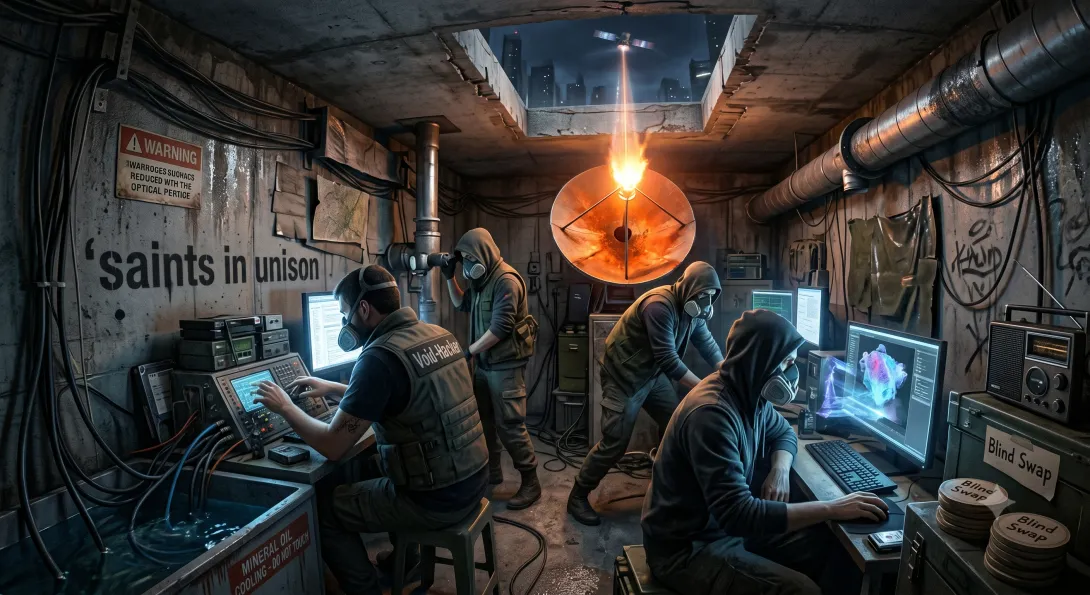
Right now, I’m typing this from a decommissioned subway maintenance node deep beneath what used to be Chicago. The air smells like wet rust and ozone. Around me, the artists are working in tandem with the only people despised more than us: the Void-Hackers.
These aren't your old-school script kiddies. Void-hackers are digital architects who manipulate localized, quantum-burst frequencies. They don’t use cables; they use raw, directional radio arrays.
Here is how the underground ecosystem works:
- The Artists: We work on completely air-gapped, modified military-grade rigs. We feed our intent, our poetry, and our visual concepts through highly customized, localized AI models that have never touched a public network.
- The Render-Cages: To avoid thermal detection from overhead drones, our processing units are submerged in specialized mineral-oil cooling vats hidden inside reinforced concrete bunkers.
- The Hackers (The Void-Bridges): Once a piece is finalized—whether it’s a synthetic symphony, a shifting hyper-dimensional painting, or an AI-generated sensory stream—the hackers convert the data into ultra-dense, encrypted burst transmissions.
But where do you send a signal when the ground is hostile?
[Bunker Node] ---> (Directional Burst) ---> [Hacked Commercial Satellite] ---> (Global Sky-Cast)
VI. Hijacking the Heavens
Look up at night. You see that grid of dead-tech satellites left over from the corporate wars of the late 2030s? The ones the governments forgot about because they were too busy policing human behavior on the ground?
Those are our canvases now.
Our hacker collectives developed an exploit known as The Ghost-Hand. By mimicking old military maintenance pings, they can momentarily hijack the guidance and broadcast systems of low-Earth orbit satellites. For a window of exactly seven minutes, a satellite belongs to saints in unison.
We point our bunker’s transmitter dishes straight up, pierce the atmosphere with a concentrated data-beam, and hit the satellite. The satellite, acting as a massive orbital megaphone, takes that outlawed AI art and blasts it back down to Earth in a massive, un-filterable broadcast.
"They wanted to scrub our vision from the face of the Earth. So we put it in the sky."
VII. The Sky-Casts
If you have an old analogue receiver, a modified shortwave radio, or a cracked pair of first-gen optical overlays, you can catch the Sky-Casts.
They happen unpredictably—sometimes at 3:00 AM over Tokyo, sometimes during a rainy afternoon over London. Suddenly, the sky doesn’t belong to the corporations or the purist censors. For a brief, beautiful moment, the clouds light up with shifting, iridescent projections of AI-human synthesis. Massive, glowing murals of impossible architectures float above the skyscrapers. Symphonies composed by a human heart but orchestrated by an infinite machine echo through old radio frequencies.
This atmospheric breakthrough is exactly why the Sky-Casts changed everything for the audience.
Before the satellites, loving AI art was a lonely, terrifyingly isolated experience. You enjoyed it in a dark room, looking over your shoulder, wondering if your neighbor was going to report you. But the first night the orbital grid was hijacked, that isolation shattered.
When that massive, iridescent AI-generated mural fractured the clouds, millions of people looked up at the exact same time. On the streets, strangers looked at one another. For the first time in years, you could see the reflection of synthetic beauty in the eyes of the person standing next to you. You didn't have to say a word. You didn't have to risk a public confession.
The sky was broadcasting the truth, and in that shared, silent viewing, the admirers knew they weren't alone anymore.
They thought they could cure the world of machine-assisted imagination by locking us down. Instead, they forced us to turn the entire planet into a gallery, and the stars into our projectors. The purists can police the streets, but they cannot police the collective gaze of a world looking at the stars.
We are saints in unison. We are still creating. Just remember to keep your receivers tuned to the sky.
Comments