
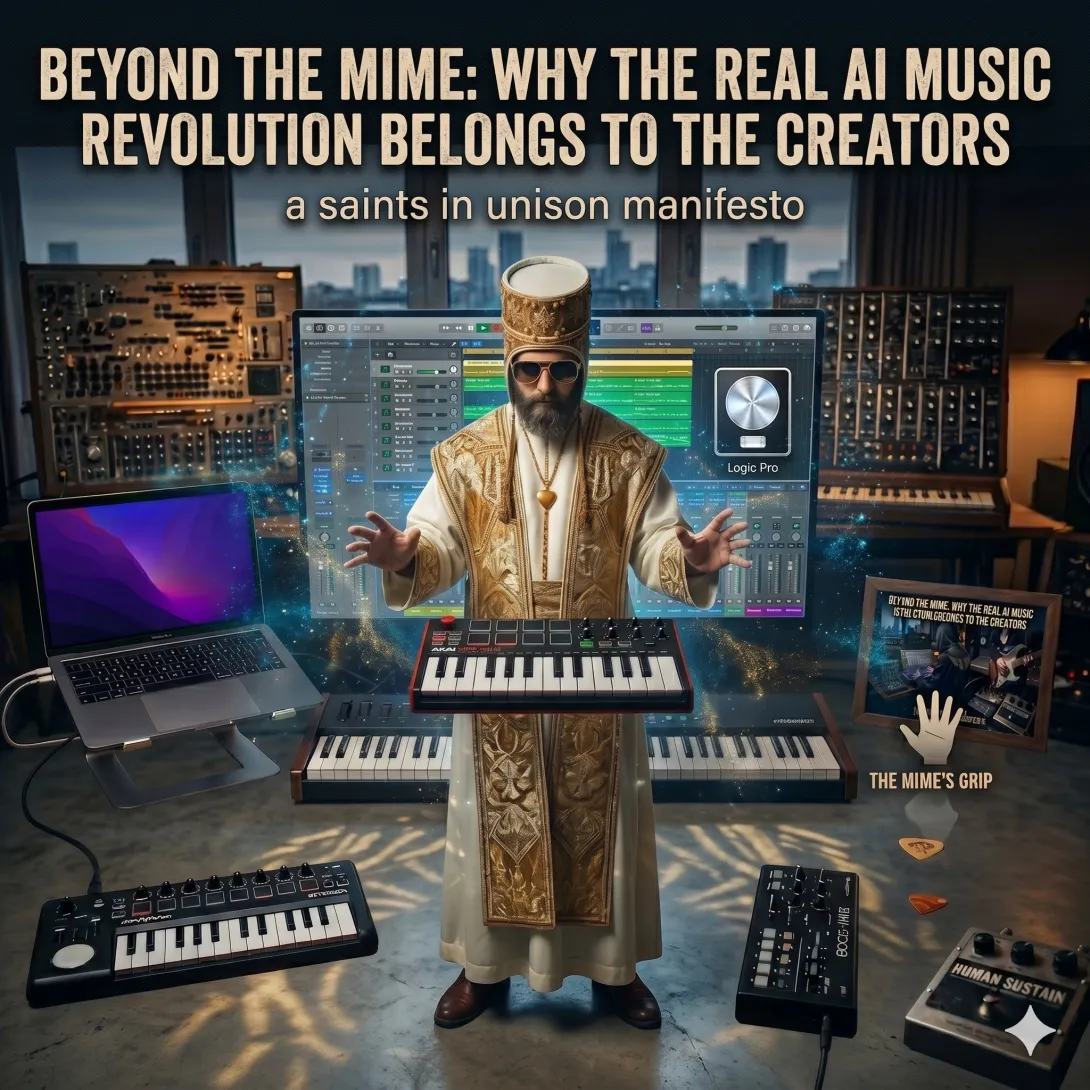
Beyond the Mime: Why the Real AI Music Revolution Belongs to the Creators, Not the Grifters
We usually stay out of the fray. If you follow saints in unison, you know we prefer to let the music, the digital art, and the worlds we build speak for themselves. We have a massive dog in this fight, but watching the endless, exhausting discourse on social media usually just makes us want to retreat further into the studio, turn off the internet, and create.
But every now and then, a story breaks that is so egregious, so fundamentally lazy, that it forces our hand.
By now, you’ve probably seen the news about the latest "artist" to be exposed. The headline isn't just that she was using AI; it’s how she did it. She literally ripped AI-generated music straight out of an existing video, slapped her name on it, and spent her energy miming along on a blues guitar, pretending her hands were the ones creating that sonic brainchild.
It’s pathetic. It’s a cheap hustle. Guitar nerds and producers have literally been trying to recreate the tone and physics of the track she's "playing," chaining together different electric guitars and stack after stack of effects pedals, but they can't match it. Why? Because you cannot humanly achieve that infinite, unnatural machine sustain on a real rig. She’s faking a performance over an impossible AI file, and honestly, it infuriates us—not because AI was involved, but because this kind of blatant fraud gives an easy weapon to the army of critics who want to burn down the entire landscape of AI-assisted art.
When people see someone faking a blues solo to a stolen, automated audio file, it justifies every single lazy stereotype about AI music. It lets the detractors point their fingers and scream, "See? It’s all just a soulless, button-pressing fraud!"
But they are missing the entire point of what legitimate creators are doing with these tools.
The Myth of the "Pure" Past vs. Real Human Slop
Let’s talk about those gatekeepers for a minute—the ones who constantly gripe, moan, and hate on anyone integrating machine learning into their creative workflow. They operate under this bizarre, romantic delusion that everything made entirely by human hands is inherently sacred, brilliant, and pure.
Let’s be completely fucking real for a second: there is a staggering amount of human slop out there that is absolutely disgusting.
Every single day, the traditional industry pumps out formulaic, uninspired, cookie-cutter garbage. It’s written by committee, tuned to death by VariAudio and Auto-Tune, stripped of any real dynamic range, and engineered purely to satisfy a demographic spreadsheet. It is corporate, safe, brain-dead human slop—and people make absolute bank on it.
Yet, because a human being sat in a room and copy-pasted a chord progression that’s been used ten thousand times before, the purists call it "legitimate art."
For us, AI isn't an escape hatch from hard work. It isn't a way to bypass learning an instrument so we can spend our time play-acting for a camera. We use AI as a collaborator. We use it to generate stems, to spark alien concepts, and to push us out of our comfort zones. But the heavy lifting? The arrangement, the live keyboard tracking, the instrumentation, the vocal direction, the narrative lore, the mixing—that is deeply human. It takes decades of musical intuition to take a raw machine-generated concept and mold it into a piece of electronic music that actually has a pulse, a vibe, and a soul.
AI doesn't replace the artist; it advances the art. It expands the canvas. The problem isn’t the technology; it’s the lack of imagination and integrity in the people exploiting it.
The Music Industry Has Always Been Broken
The irony of the current moral panic over AI is that it’s happening inside an ecosystem that has been predatory and broken since its inception. The industry has never cared about the independent creator, and it certainly doesn't care now.
Think about traditional terrestrial radio. For decades, it has been a playground of consolidation and payola. Songs are blasted out to millions of listeners for "free." But did you know that for a vast majority of independent, mid-tier artists, they never see a single penny from those terrestrial broadcasts? Traditional radio stations in the US don't pay performance royalties to the sound recording owners—only to songwriters—and even then, the tracking systems are heavily weighted toward major label rosters. If you aren't in the machine, you are invisible.
And if you think the modern streaming landscape fixed that, you haven't looked at your backend dashboard lately.
The streamers love to market themselves as democratizing platforms, but the reality is a black box. Stations and platforms routinely fail to accurately report or distribute plays for independent artists. Millions of streams slip through the cracks, untracked and unpaid, while the tech executives and major labels split the top-tier pool.
The Algorithmic Erasure of Electronica
As independent producers working deeply within electronic music, we see firsthand how the cards are stacked against us. The entire architecture of modern streaming services relies on recommendation algorithms designed to minimize risk.
These algorithms don't reward sonic experimentation, deep atmospheric textures, or genre-bending electronics. They reward passivity. They are optimized to feed the listener "lean-back" music—auditory wallpaper that sits quietly in the background while someone studies or cleans their kitchen.
If your music doesn't fit neatly into a pre-ordained, hyper-specific mood playlist, the algorithm chokes it. It starves independent electronic producers of visibility because we don't make safe, predictable, acoustic background noise. We are actively left out of the loop by code that values retention over artistic expression.
Setting the Standard
This brings us back to the miming, the physics-defying sustain, and the fraud.
When an "artist" steals an AI track and fakes a guitar solo, they aren't just cheating the audience—they are validating the very algorithms and corporate structures that want to keep music small, cheap, and easily automated. They are treating music as content to be consumed in 15-second intervals rather than an art form to be lived in.
We refuse to play that game. We use every tool at our disposal—human, digital, and synthetic—to build something real, independent, and uncompromising. We don't need a broken industry's permission, we don't need a major label's budget, and we sure as hell don't need to fake our way through a performance.
The grifters will always find a way to grift, whether they're using an AI generator or a ghostwriter. But for those of us pushing the boundaries of what technology and human instrumentation can achieve together, the work continues.
Stay tuned. We're just getting started.
Comments